Introduction: 112G Is Reaching Its Limit
As AI clusters continue to scale to tens of thousands of GPUs, network infrastructure is being pushed to its limits. In modern data centers, performance is no longer defined solely by compute power—bandwidth, latency, and energy efficiency have become equally critical.
For years, 112G SerDes has served as the foundation of high-speed networking, supporting the transition from 400G to early 800G deployments. However, as demand for higher throughput and better efficiency accelerates, its limitations are becoming increasingly apparent.
The shift to 224G SerDes is not simply an incremental upgrade. It represents a structural change in how high-speed systems are designed. By doubling per-lane bandwidth, 224G enables a new generation of 800G and 1.6T architectures while simultaneously reducing system complexity, power consumption, and physical constraints.
Article Highlights:
-
224G SerDes doubles per-lane bandwidth compared to 112G
-
Enables 800G with 4 lanes and 1.6T with 8 lanes
-
Reduces PCB complexity and power consumption
-
Critical for AI, hyperscale, and HPC networks
What Is SerDes?
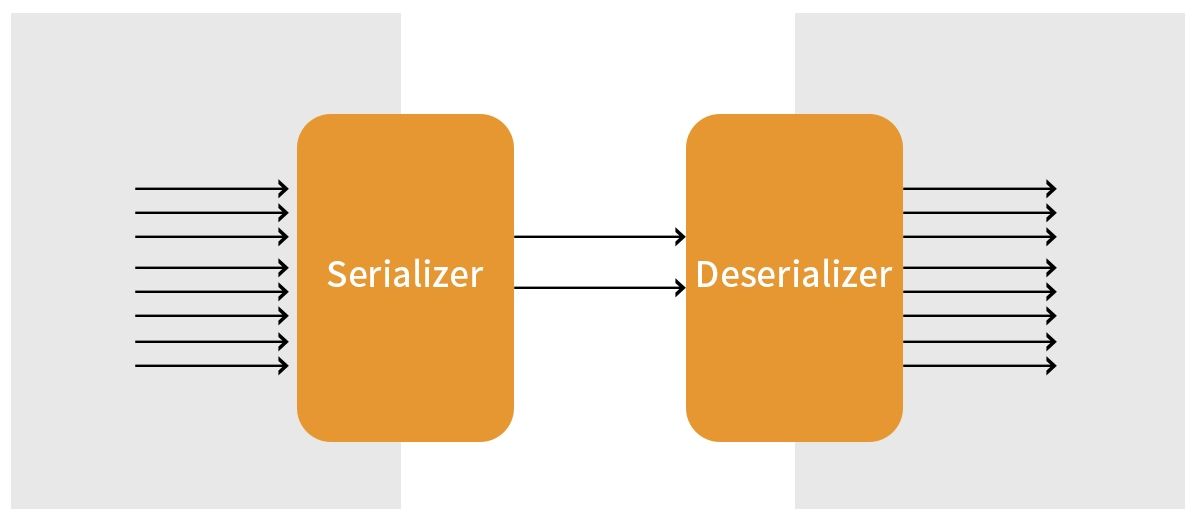
SerDes (Serializer/Deserializer) is a high-speed interface that converts parallel data into serial signals for transmission between switch ASICs and optical modules.
Figure 1: Serializer/Deserializer Architecture
By reducing the number of physical I/O connections, SerDes allows data centers to achieve higher bandwidth within limited space — a key requirement in modern AI infrastructure.
The Evolution of SerDes: From 25G to 224G
The evolution of SerDes has followed a predictable pattern: each generation doubles bandwidth per lane to keep pace with growing network demands. From 25G using NRZ signaling to 50G and 112G with PAM4 modulation, each step has extended the life of existing architectures.
Now, 224G marks the next frontier. It maintains PAM4 modulation but pushes signaling to a level where traditional electrical design assumptions begin to break down. At this scale, improvements are no longer just about speed—they directly impact system architecture, thermal design, and overall network economics.
| Generation |
Lane Speed (Per Lane) |
Modulation |
| 25G |
25Gbps |
NRZ |
| 50G |
50Gbps |
PAM4 |
| 112G |
112 Gbps |
PAM4 |
| 224G |
224 Gbps |
PAM4 |
224G SerDes vs 112G: What's the Difference?
| Feature |
112G SerDes |
224G SerDes |
Strategic Impact |
| Lane Speed |
112Gbps |
224Gbps |
2× bandwidth |
| 800G Design |
8 lanes |
4 lanes |
50% reduction in PCB complexity |
| 1.6T Feasibility |
Challenging (16 lanes) |
Practical (8 lanes) |
Enables standard OSFP224 form factors |
| Power Efficiency |
Moderate |
Improved |
Lower power consumption per bit |
| PCB Complexity |
High |
Reduced |
Easier routing |
224G doesn't just increase speed — it reduces system complexity by half.
At first glance, the difference between 112G and 224G appears straightforward: one simply doubles the bandwidth of the other. In practice, the implications are far more significant.
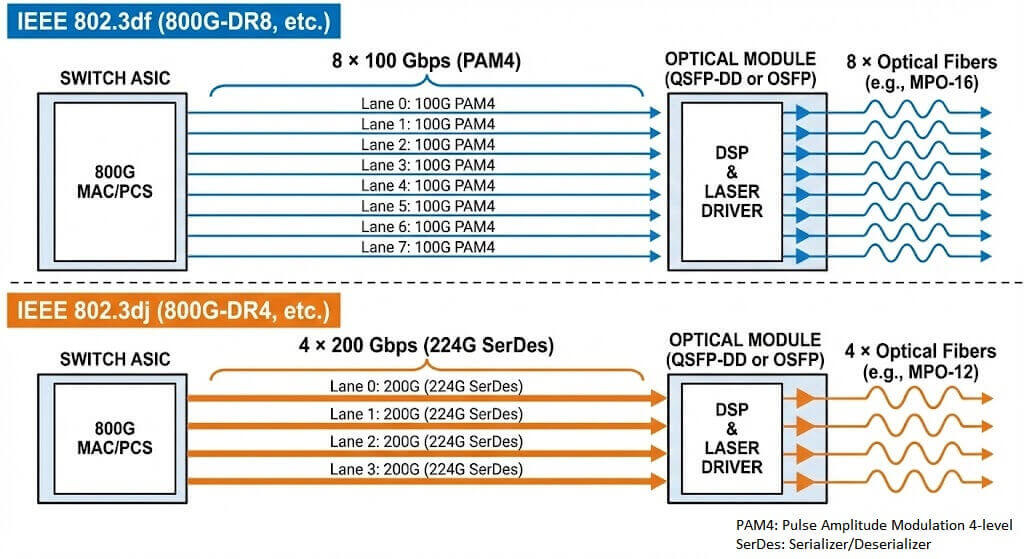
With 112G SerDes, an 800G optical module typically requires eight electrical lanes. Moving to 224G reduces that requirement to just four. This seemingly simple reduction has a cascading effect across the entire system. Fewer lanes mean fewer high-speed traces on the PCB, which simplifies routing, improves signal integrity, and reduces insertion loss.
Figure 2: 800G Transceiver Architecture: 8x100G vs 2x400G electrical lanes
The impact becomes even more pronounced at 1.6T. Attempting to build a 1.6T module with 112G would require sixteen lanes, pushing beyond the physical and thermal limits of standard pluggable form factors. In contrast, 224G enables 1.6T with only eight lanes, making it viable within emerging designs such as OSFP224.
In this sense, 224G does more than increase bandwidth—it effectively cuts system complexity in half while opening the door to the next generation of networking speeds.
Why 224G Is Critical for 800G and 1.6T Optical Modules
224G SerDes is becoming a core technology for 800G optical modules, 1.6T transceivers, and OSFP224 form factors. Compared with 112G SerDes, it significantly improves bandwidth density and power efficiency, making it ideal for AI data center networking, hyperscale cloud infrastructure, and high-performance computing environments.
Reducing Lane Count
In the 112G era, an 800G optical module required 8 electrical lanes (8 x 100G). With 224G SerDes, the same 800G capacity can be achieved using only 4 lanes. This reduction simplifies the internal architecture of the module and reduces the complexity of the host PCB.
Enabling 1.6T Throughput
The most significant impact of 224G is the realization of 1.6T interconnects. Attempting to build a 1.6T module using 112G SerDes would require 16 lanes, which exceeds the physical pin density and thermal limits of standard form factors like OSFP or QSFP-DD. By using 224G, a 1.6T module can be built with just 8 lanes, maintaining a manageable footprint. This is what makes OSFP224 and next-gen pluggables possible.
Enhanced Port Density and Efficiency
Fewer lanes per module translate directly to higher port density on the switch faceplate. Furthermore, reducing the number of active electrical paths often leads to improved overall system efficiency and lower power consumption per bit.
Engineering Challenges Behind 224G SerDes
Operating at frequencies near 112GHz (depending on modulation) requires a more detailed explanation of the material science involved.
Signal Integrity and Insertion Loss
Operating at 224G speeds introduces severe physical challenges, as electrical signals degrade rapidly through copper traces. This necessitates the transition to Ultra-Low-Loss (ULL) PCB materials and significantly shorter trace lengths.
Advanced DSP and FEC
To combat high Bit Error Rates (BER), 224G modules rely on sophisticated Digital Signal Processors (DSP) and advanced Forward Error Correction (FEC) algorithms to ensure data reliability in noisy environments.
Thermal and Mechanical Design
224G components generate intense heat in compact areas, requiring integrated heat sinks (IHS) and optimized airflow paths within the OSFP224 form factor to prevent thermal throttling.
From Pluggable Optics to CPO and LPO
224G SerDes is the linchpin not only for pluggable modules but also for accelerating the transition to next-gen architectures:
-
Linear Pluggable Optics (LPO): By leveraging 224G SerDes to drive signals directly without a power-hungry DSP, LPO reduces latency and power consumption—ideal for high-frequency AI training.
-
Co-Packaged Optics (CPO): 224G accelerates the shift toward CPO, where the optical engine is brought into the same package as the ASIC to virtually eliminate the electrical path loss.
These architectures further reduce power consumption and latency by bringing optics closer to the ASIC.
Enabling High-Performance 224G Deployments
To fully realize the benefits of 224G SerDes, the surrounding optical interconnect ecosystem must also evolve. High-performance optical modules, along with optimized cabling and connectivity solutions, play a crucial role in ensuring stable and efficient operation at these speeds.
In practical deployments, this includes 800G and 1.6T optical transceivers, high-density fiber cabling systems, and low-power interconnect solutions such as DAC and AOC. When properly integrated, these components help maximize bandwidth utilization while keeping power consumption and thermal impact under control.
For data center operators, selecting the right combination of these technologies is essential to unlocking the full potential of 224G-based architectures.
Should You Upgrade to 224G Now?
You should consider 224G SerDes if:
-
You are deploying 1.6T interconnects where 16-lane 112G is physically impossible.
-
You need to maximize faceplate port density for large-scale GPU clusters.
-
Your operational goals prioritize lowest power-per-bit to manage escalating data center energy costs.
For legacy or cost-sensitive deployments, 112G may still be viable — but it will not scale efficiently for future AI workloads.
Conclusion
The transition to 224G SerDes is the linchpin of the next era of high-speed networking. By enabling the shift to 800G (4-lane) and 1.6T (8-lane) architectures, it provides the bandwidth necessary to support the global AI revolution. While the engineering challenges are formidable, the innovations in signal integrity, DSP, and thermal management ensure that 224G will be the standard for high-performance data centers for years to come.

 English