
 English
As AI models continue to scale and training clusters expand toward hundreds of thousands of GPUs, data center networks are rapidly entering the 1.6T (XDR) era. At this bandwidth level, network architects are no longer facing a simple speed upgrade, but a fundamental architectural decision: should future networks adopt Co-Packaged Optics (CPO), or will pluggable optical modules remain the dominant solution?
The answer is not absolute. Both technologies play important roles at 1.6T, but they serve very different timelines, deployment models, and operational realities. Understanding these differences is essential for building scalable, cost-effective, and future-ready XDR networks.
Why 1.6T Changes the Optical Architecture?
The transition from 800G to 1.6T represents more than a doubling of bandwidth per port. It pushes electrical signaling, power delivery, and thermal management closer to their physical limits.
At 1.6T, the electrical interface between the switch ASIC and the optical engine becomes a critical bottleneck. Longer PCB traces introduce higher signal loss and require more aggressive DSP compensation, increasing both power consumption and system complexity. As a result, traditional assumptions about pluggable optics are being challenged, and alternative architectures like CPO are gaining attention.
However, technical feasibility alone does not determine real-world adoption.
What Is CPO and Why It Attracts Attention at 1.6T?
Co-Packaged Optics places the optical engines directly adjacent to the switch or compute ASIC within the same package or substrate. By shortening electrical interconnects from centimeters to millimeters, CPO dramatically reduces signal loss and improves energy efficiency.
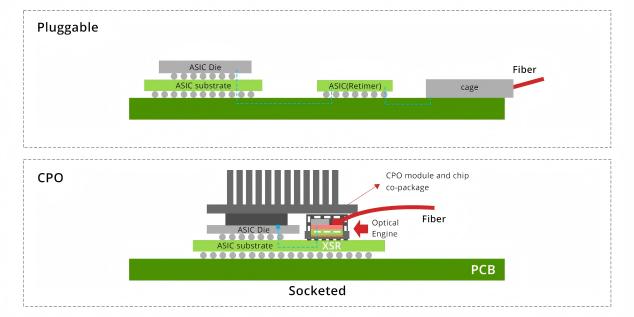
From a pure performance perspective, CPO offers compelling advantages for ultra-high-speed networks. Lower power per bit, reduced latency, and higher bandwidth density make it highly attractive for future 1.6T and even 3.2T systems. For hyperscale AI fabrics where power efficiency is paramount, CPO represents a long-term architectural evolution rather than a simple module upgrade.
Yet, these benefits come with significant practical trade-offs.
The Challenges of CPO Deployment
Despite its technical promise, CPO is not yet ready to replace pluggable optics at scale.
Serviceability remains the most frequently cited concern. Unlike pluggable optical modules, CPO solutions are not field-replaceable. A failure in the optical engine may require replacing an entire switch or line card, significantly increasing operational risk and maintenance costs.
Thermal and mechanical integration further complicate adoption. Combining high-power switch ASICs and optical engines within the same package increases cooling complexity and impacts manufacturing yield. In addition, industry standards for CPO are still evolving, resulting in a fragmented ecosystem with limited interoperability compared to the mature pluggable optics market.
As a result, CPO today is best viewed as a forward-looking technology roadmap rather than an immediate solution for most 1.6T deployments.
Why Pluggable Optics Remain the Practical Choice at 1.6T?
While CPO captures long-term attention, pluggable optics continue to be the backbone of real-world data center networks—and they are rapidly evolving to meet 1.6T requirements.
Modern 1.6T pluggable optical modules leverage advanced DSPs, high-speed PAM4 modulation, and thermally optimized form factors such as OSFP. Solutions like 1.6T OSFP 2xDR4/DR8 and 2xFR4/FR8 enable operators to double bandwidth while maintaining familiar deployment and maintenance models.
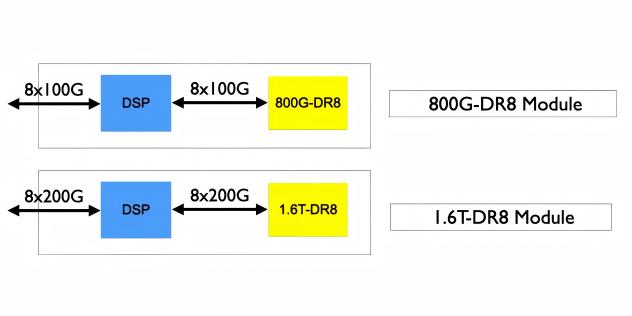
The key advantage of pluggable optics lies in operational flexibility. They are hot-swappable, widely interoperable, and fully aligned with existing data center workflows. For organizations upgrading incrementally from 800G, pluggable optics offer a lower-risk, faster time-to-market path to 1.6T without forcing radical changes to network architecture or operations.
For most AI data centers and XDR networks deploying 1.6T in the near term, this practicality outweighs the theoretical efficiency gains of CPO.
CPO vs Pluggable Optics at 1.6T: A Practical Comparison
At 1.6T, the contrast between CPO and pluggable optics becomes clear. CPO delivers superior power efficiency and ultra-low latency, making it attractive for future ultra-large-scale AI systems. Pluggable optics, on the other hand, offer proven reliability, ecosystem maturity, and deployment flexibility that align with today's operational realities.
CPO represents a long-term architectural shift, while pluggable optics provide an immediately deployable solution. In terms of time to market, risk control, and serviceability, pluggable optics remain the more viable option for most data centers today.
Which Is Better for 1.6T XDR Networks?
For near-term 1.6T XDR deployments, pluggable optics are the clear choice. They allow network operators to scale bandwidth quickly, reuse existing infrastructure, and maintain predictable operational models.
CPO is better suited for future generations of AI fabrics, where extreme power efficiency and bandwidth density justify changes in system design and maintenance philosophy. As standards mature and operational models evolve, CPO is expected to play a larger role beyond the first wave of 1.6T deployments.
In other words, the decision is not about choosing one technology over the other. It is about choosing the right technology for the right phase of network evolution.
Conclusion
The transition to 1.6T is not a zero-sum competition between CPO and pluggable optics. It is a phased evolution. Pluggable optics will continue to dominate 1.6T XDR networks in the foreseeable future, offering flexibility, compatibility, and rapid deployment. CPO will shape the next generation of optical architectures, influencing how networks are designed beyond 1.6T. For data center architects and AI infrastructure builders, the smartest strategy is clear: deploy pluggable 1.6T optical modules today while keeping a close eye on CPO developments for tomorrow.
Recommended Reading:


