As AI workloads continue to scale into the trillion-parameter era, the network is no longer just a utility—it is the bottleneck. From Large Language Model (LLM) training to massive GPU fabrics, the demand for ultra-high-speed interconnects is pushing traditional 400G and 800G infrastructures to their physical limits. This is where OSFP224 emerges as a key enabler for next-generation networking. Designed to support 1.6T throughput, OSFP224 is not just about higher speeds—it introduces a new level of deployment flexibility.
For network architects, the strategic challenge is no longer whether to adopt 1.6T, but how to deploy it: Should you deploy OSFP224 in 1×1.6T Native mode for maximum performance, or use 2×800G breakout mode for flexibility and compatibility? This article breaks down both strategies to help you make the right decision.
What Is OSFP224? A Foundation for 1.6T Networking
OSFP224 is a high-speed pluggable optical module designed to support 224G PAM4 signaling per lane across 8 lanes, delivering a total bandwidth of 1.6Tbps. The "224" in its name signifies the leap to 224Gbps per lane, doubling the efficiency of the previous 112G generation.
Unlike previous generations, OSFP224 is not limited to a single deployment model. It supports both:
This dual-mode capability makes OSFP224 a key technology for AI data center network upgrades, allowing operators to transition from 800G to 1.6T without a complete infrastructure overhaul.
Mode 1: 1×1.6T Native — Maximum Performance for AI Scale-Up Networks
Deploying OSFP224 in 1×1.6T Native mode is the gold standard for next-generation AI "Scale-Up" networks. This configuration is optimized for environments where microsecond latency and maximum throughput are non-negotiable. For the deeper insights in 1.6T OSFP224 deployment, refer to our guide -
End-to-End 1.6T OSFP224 Interconnect Solution for AI Data Centers.
Minimizing Tail Latency: In distributed AI training, the "All-Reduce" operations between GPUs are highly sensitive to network hops and congestion. A native 1.6T link provides a massive, unified pipe that minimizes packet serialization delay.
Backbone Aggregation: This mode is the ideal choice for the Spine Layer of AI fabrics. By doubling the per-port capacity, architects can reduce the total number of required fiber links and switch interconnections, simplifying the network topology and reducing points of failure.
Infrastructure Synergy: Native 1.6T deployment aligns perfectly with the latest generation of 51.2T and 102.4T switching ASICs, providing a future-proof foundation for Blackwell-class GPU clusters.
Mode 2: 2×800G Breakout — Flexible and Cost-Efficient for Gradual Migration
The alternative is to deploy OSFP224 in 2×800G breakout mode, logically splitting a single
1.6T OSFP224 module into two independent 800G channels. This approach offers a more practical path for many data centers that are not ready for full 1.6T adoption.
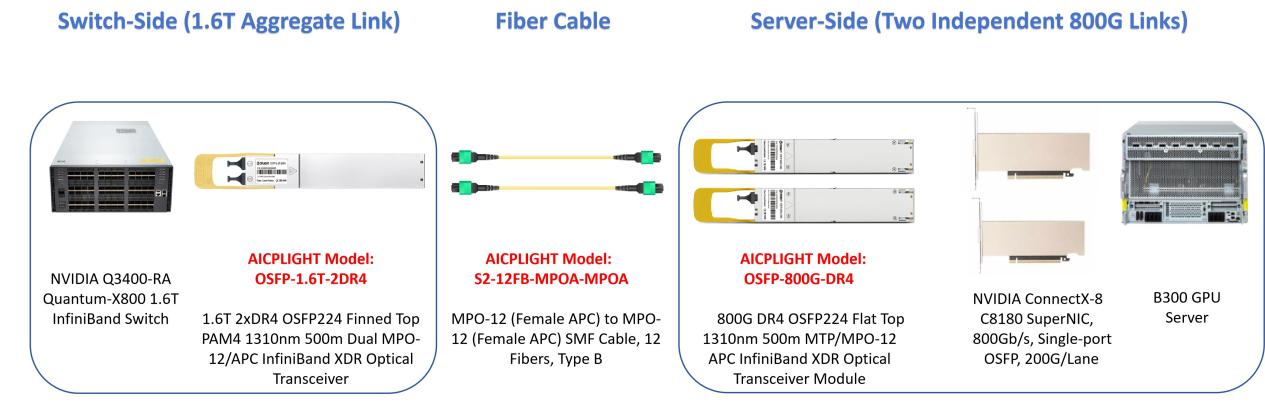
Figure 1: This technical diagram illustrates a 1.6T to 2×800G breakout configuration for InfiniBand XDR networks, featuring OSFP224 transceivers that utilize 200G per lane PAM4 modulation to connect an NVIDIA Quantum-X800 switch to a B300 GPU server.
Seamless Legacy Integration: By leveraging breakout configurations, operators can connect to existing 800G switches, enabling gradual upgrades without replacing current switching infrastructure. This breakout is typically achieved via MPO cabling, allowing a single 1.6T port to interface seamlessly with two legacy 800G OSFP/QSFP-DD ports.
Maximized Switch Radix: Breakout configurations allow architects to double the number of addressable endpoints (Leaf switches or NICs) from a single Spine switch. This is a "Secret Weapon" for increasing the scale of a cluster without adding expensive switching layers.
OPEX Efficiency: This mode enables a phased migration. Operators can deploy 1.6T-ready switches today and run them in 800G mode, deferring the cost of a full 1.6T optics rollout until the workload truly demands it.
1×1.6T vs 2×800G: Key Differences in Deployment Strategy
When choosing between the two modes, it's important to evaluate them across multiple dimensions.
| Architectural Dimension |
1×1.6T Native |
2×800G Breakout |
| Spectral Efficiency |
Maximum; optimized for 224G SerDes. |
High; maximizes port utility. |
| Ecosystem Ready |
Requires next-gen 1.6T ASICs. |
Compatible with current 800G fabrics. |
| Cabling Complexity |
Simplified; lower cable count. |
Higher; requires breakout assemblies. |
| Thermal Profile |
Concentrated; requires OSFP224 cooling. |
Distributed; lower per-link heat. |
| Best Use Case |
AI Training / HPC Backbones. |
Cloud Leaf-Spine / Hybrid Clusters. |
Bandwidth Density
-
1×1.6T delivers higher per-port throughput, making it ideal for dense, high-performance environments.
-
2×800G offers flexibility but with lower density per logical link.
Compatibility
-
2×800G has a clear advantage, as it works seamlessly with existing 800G ecosystems.
-
1×1.6T requires next-generation switching platforms.
Cost Efficiency
Scalability
Deployment Scenarios: Which One Should You Choose?
In real-world deployments, the choice often depends on your network architecture and upgrade timeline.
For AI training clusters with high-performance GPUs, 1×1.6T is the better option. It minimizes latency and maximizes throughput, which are critical for distributed training efficiency.
For enterprise or cloud data centers undergoing gradual upgrades, 2×800G provides a safer and more economical approach. It allows you to scale bandwidth without replacing your entire switching infrastructure.
For mixed environments, a hybrid strategy is often the most effective. You can deploy 1.6T in the spine layer while using 2×800G in the leaf layer, achieving both performance and flexibility.
The Migration Path: From 800G to 1.6T
One of the biggest advantages of OSFP224 is that it enables a smooth migration path rather than a disruptive transition.
Organizations can start with 2×800G deployments today and gradually transition to 1×1.6T as:
-
1.6T switch ASICs become widely available
-
Optical module costs decrease
-
AI workloads demand higher bandwidth
This staged approach reduces risk while ensuring your network is ready for future growth.
Conclusion
OSFP224 is more than just a high-speed optical module—it is a flexible platform for data center evolution. If your priority is maximum performance and future scalability, deploying OSFP224 in 1×1.6T Native mode is the best choice. If your focus is compatibility and cost efficiency, 2×800G breakout offers a more practical solution. For most AI data centers, a combination of both strategies will provide the optimal balance between performance, cost, and flexibility.

 English