
 English
As NVIDIA accelerates its product refresh cycles from early Tesla GPUs to the current GB200 series, base network speeds have surged from 10G to 1.6T. While 1.6T networks are drawing significant industry attention, they remain in limited-scale adaptation and have yet to achieve full commercial deployment. In contrast, 800G has emerged as the mainstream choice for major AI computing centers. Optical modules serve as the critical networking foundation for data centers - from SFP to QSFP and now OSFP, each form factor evolution represents not just a leap in transmission speeds but also provides robust support for cutting-edge fields like scientific computing and AI training.
This article will systematically examine the development history, core technologies, key specifications, and typical application scenarios of 800G optical modules. Whether you're planning upgrades for existing data centers or deploying next-generation high-performance computing clusters, this guide will help you thoroughly understand the technical essence of 800G optical modules and make more precise selection decisions.
I. What is an 800G Optical Module?
The most prevalent 800G optical module packaging format currently available is OSFP (Octal Small Form-factor Pluggable). OSFP is an eight-channel pluggable optical module supporting 800G high-speed transmission, specifically engineered to meet the demanding requirements of hyperscale data centers and high-performance computing (HPC) environments.
"Octal" denotes its eight-channel electrical interface design, significantly differentiating it from traditional four-channel QSFP modules. "Small Form-factor" indicates its compact packaging, enabling high-density deployment in limited spaces. "Pluggable" emphasizes its support for hot-swap functionality, facilitating module replacement and maintenance during device operation. This greatly enhances operational flexibility and system availability.
The OSFP (Octal Small Form-factor Pluggable) is currently the dominant 800G optical module form factor. Designed for hyperscale data centers and high-performance computing (HPC), it delivers:
- Octal Architecture: 8-channel electrical interface (significantly differentiating it from traditional four-channel QSFP modules).
- High-Density Design: Compact form factor enables dense deployment.
- Hot-Swappable: Live replacement capability minimizes downtime and enhances operational flexibility and system availability.
II. Technical Advantages of OSFP
1. Unique Thermal Design
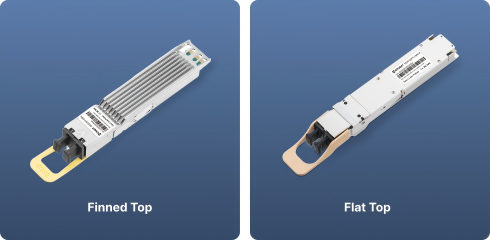
Finned-Top Design
Integrates metal cooling fins, effectively enhancing thermal efficiency by increasing contact area. It reduces module operating temperatures by 20%–30%. Tailored for high-power air-cooled switches, this solution handles substantial heat generated during prolonged full-load operation, ensuring signal stability and component longevity.
Flat-Top Design
For applications with limited vertical space, such as GPU servers and liquid-cooled cabinets, OSFP offers a flat-top module design. While these modules have inherently lower self-cooling capacity, they leverage the host system's efficient liquid cooling or thermal pathways for synergistic heat dissipation. This enables higher hardware density without compromising performance.
These two thermal designs are not mutually exclusive but represent targeted optimizations for different application platforms, demonstrating OSFP's high adaptability across diverse deployment scenarios.
2.Low-Power Design
In terms of energy efficiency, OSFP achieves a significant breakthrough compared to traditional CFP8 and QSFP-DD solutions, reducing overall power consumption by approximately 40%. Taking a typical 800G OSFP module as an example, its power consumption is generally controlled within the range of 13.5W–15W. This achievement stems from advanced signal processing algorithms and circuit architecture optimization, substantially reducing energy consumption per unit bandwidth while maintaining high throughput. This not only helps decrease overall data center power consumption and lower PUE values but also aligns with global strategic priorities for green and sustainable development.
III. Types of 800G OSFP Optical Modules
1.800G OSFP 2×SR4 / SR8
- Positioning: A cost-effective solution for multimode fiber (MMF) interconnects.
- Core Technology: Combines Broadcom VCSEL arrays and DSP chips for high reliability and consistency.
- Key Advantages: Supports up to 50m transmission over OM4 MMF. Typical power consumption <15W, offering excellent cost-performance.
- Applications: Ideal for short-reach direct connections between switches and servers in HPC environments. Optimized for Top-of-Rack (ToR) intra-rack interconnects.
2. 800G OSFP 2×DR4 / DR8
- Positioning: High-efficiency single-mode fiber (SMF) solution for short-distance applications.
- Core Technology: Designed for up to 500m transmission with <16W typical power consumption.
- Key Advantages: Ultra-low latency with BER (Bit Error Rate) as low as 1E-10, ensuring data integrity.
- Applications: Commonly used for medium-to-short-distance connections between switches in HPC architectures.
3. 800G OSFP 2×FR4 / FR8
- Core Technology: Utilizes dual-channel CWDM (Coarse Wavelength Division Multiplexing) for bidirectional four-wavelength transmission, maximizing fiber utilization.
- Key Advantages: Reduces fiber count, simplifying cabling and lowering management costs. Enhances inter-rack connection density in data centers.
-
Applications: Optimized for high-density data centers. Ideal for cross-floor or cross-room medium-distance(500m–2km) connections in large-scale deployments.
IV. What's the Difference Between Branded and Third-Party 800G OSFP Optical Modules?
| Comparison Dimension | Branded OEM Modules | Third-Party Compatible Modules |
|---|---|---|
| Compatibility Testing | Fully validated with OEM switch systems through end-to-end testing | Cross-tested with major brands (NVIDIA, Cisco, Arista, Juniper) under stress conditions |
| Pricing | 30-60% higher with brand premium and bundled services | More cost-effective with transparent pricing |
| Lead Time | Unstable due to prioritized allocations for key accounts | Faster turnaround with flexible delivery options |
| Warranty & Support | Extended warranties often require additional contracts | Typically includes free replacement/repair policies |
| Technical Assistance | Comprehensive but slower official support channels | More responsive with dedicated FAE teams |
As the optical module supply chain matures, quality has become more consistent across vendors. By selecting MSA (Multi-Source Agreement)-certified products, third-party modules certified under MSA (Multi-Source Agreement) standards can deliver equivalent performance to OEM modules in real deployments.
VI. How to Choose the Right 800G OSFP Optical Module
1. Match the Port Type
Different brands of 800G equipment utilize varying port form factors. the device port specifications:
- OSFP Ports → Must use 800G OSFP modules
- QSFP-DD Ports → Require QSFP-DD modules
2. Select by Transmission Distance
Optimize cost and reliability by choosing modules suited for your cabling environment:
| Distance | Module Type | Fiber Patch Cable |
|---|---|---|
| ≤ 50 m | 800G OSFP SR8 | OM4 MMF (MPO-12 APC connector) |
| 50 m ≤ 500 m | 800G OSFP DR8 | SMF (MPO-12 APC connector) |
| 500 m ≤ 2 km | 800G OSFP FR8 | SMF (Duplex LC UPC connector) |
VII. FAQs on 800G OSFP Optical Modules
Q: Can 800G OSFP optical modules be used in 400G OSFP optical port switches?A: Yes. 800G OSFP modules feature backward compatibility and can automatically downgrade to 400G mode on switches supporting CMIS dynamic rate negotiation. They offer plug-and-play functionality without manual configuration.
Q: Can 800G OSFP modules be inserted into QSFP-DD ports?
A: No. OSFP and QSFP-DD are incompatible in physical form factor, pinout, power specifications, and thermal design. Forced insertion may cause damage. They belong to different MSA standards and are not interchangeable.
Q: Why do 800G OSFP modules commonly use APC (Angled Physical Contact) MPO connectors?
A: This minimizes reflection loss (return loss) at connection points. When light transitions between media (e.g., fiber-air-fiber), Fresnel reflection occurs. Research shows that an 8° angled physical contact (APC) polish on fiber endfaces redirects most reflected light away from the core propagation path, effectively suppressing reflection interference. Therefore, high-speed optical modules—especially single-mode long-reach models—widely adopt APC interfaces to ensure signal integrity.
Q: Differences Between 800G OSFP Modules for NVIDIA Quantum™-2 Switches vs. DGX Servers
A:
| Feature | Quantum™-2 Switch Module | DGX Server Module |
|---|---|---|
| Core Components | Identical (laser, DSP, detector), circuit design, and optical interface specifications | Identical (laser, DSP, detector), circuit design, and optical interface specifications |
| Thermal Design | Finned-top design for air cooling | Flat-top design for liquid cooling |
| Deployment Context | High-density, rack-scale cooling | Server-integrated cooling |
Note: Performance is identical; differences address thermal dissipation needs.
Q: Can 800G OSFP and 800G QSFP-DD Modules Interconnect?
A: Yes, requiring both modules are fully compatible in specifications. For example: 800G OSFP FR8 modules interconnect with 800G QSFP-DD FR8 modules. Using identical wavelength, modulation scheme, fiber type (single-mode), and interface standard (e.g., MPO-12/APC). In such cases, stable links can be established provided optical layer parameters align and both endpoints support rate negotiation (via CMIS) despite differing form factors. This cross-form-factor interconnect capability offers flexibility for integrating heterogeneous networks.


