800G OSFP224 InfiniBand XDR is the latest generation of high-performance networking technology designed for AI clusters and HPC environments. It delivers up to 800Gbps bandwidth per port using advanced 224G SerDes and PAM4 modulation, enabling ultra-low latency communication between thousands of GPUs in modern AI data centers.
As artificial intelligence workloads continue to scale toward thousands of GPUs, the demand for ultra-high-bandwidth, low-latency interconnect technologies has become more critical than ever. Traditional data center networking architectures are no longer sufficient to support the communication requirements of modern AI training clusters.
To address these challenges, next-generation networking technologies are evolving rapidly. One of the most important developments is 800G InfiniBand XDR (eXtreme Data Rate), which represents the latest generation of high-performance networking for AI infrastructure and HPC environments.
At the optics level, 800G OSFP224 optical transceivers play a key role in enabling this new generation of networking performance. These modules provide the physical optical interface that allows switches and GPU servers to exchange massive amounts of data across AI clusters.
This article explores the architecture, technical specifications, and practical applications of 800G OSFP224 InfiniBand XDR, and explains why it is becoming a foundational technology for next-generation AI data centers.
Article Highlights
-
What Is InfiniBand XDR?
-
Understanding the OSFP224 Form Factor
-
Key Specifications of 800G OSFP224 Optical Transceivers
-
Why 800G InfiniBand XDR Matters for AI Clusters
-
Applications of 800G OSFP224 Modules
-
Future Outlook: Toward 1.6T Optical Interconnects
What Is InfiniBand XDR?
InfiniBand is a high-performance networking architecture widely used in supercomputing, high-performance computing (HPC), and large-scale AI clusters. It is specifically designed to deliver extremely low latency, high throughput, and efficient GPU-to-GPU communication.
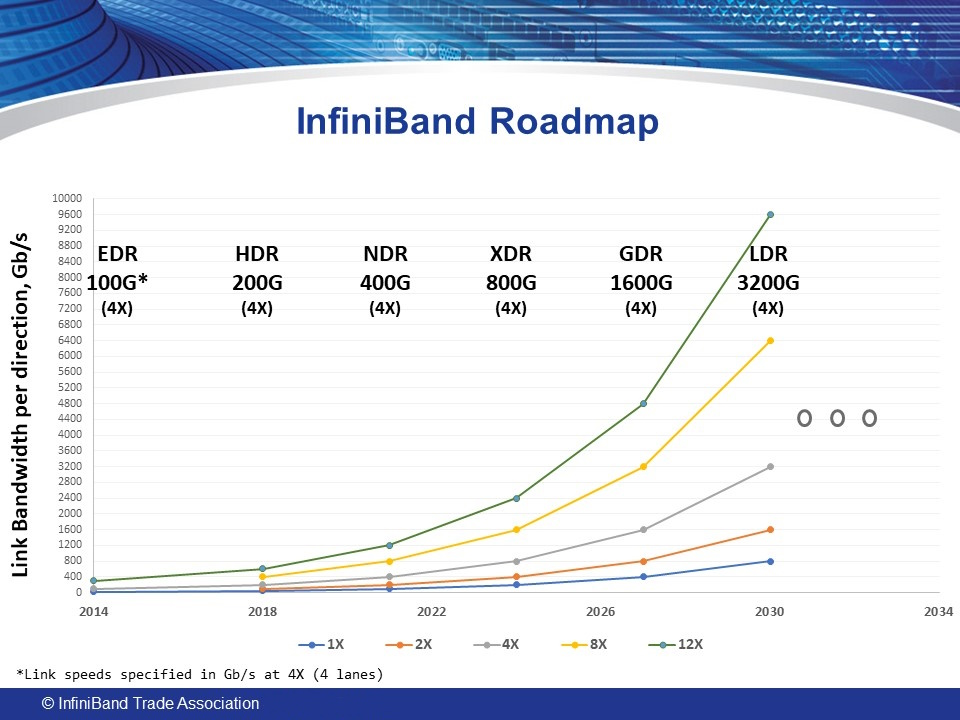
The InfiniBand roadmap has evolved through several generations: from EDR (100G) and HDR (200G) to NDR (400G).
Figure 1: InfiniBand Roadmap - EDR 100G, HDR 200G, NDR 400G, XDR 800G and future GDR 1600G, LDR 3200G (Source: InfiniBand Trade Association)
InfiniBand XDR (800G) represents the latest step in this evolution, doubling the bandwidth of the previous NDR 400G generation. This increase is particularly important for AI workloads that rely on massive parallel computing across thousands of GPUs. For the differences between NDR and XDR, refer to our guide of
NDR vs. XDR Network.
Key advantages of InfiniBand XDR include:
-
Ultra-low latency communication
-
High throughput for distributed AI training
-
Advanced congestion control
-
Native support for RDMA (Remote Direct Memory Access)
These capabilities significantly improve the efficiency of large-scale AI model training.
Understanding the OSFP224 Form Factor
The OSFP224 form factor is a next-generation optical transceiver package optimized for high-density, AI-driven, and high-performance computing (HPC) data center environments. It is an evolution of the Octal Small Form-factor Pluggable (OSFP) standard, specifically designed to support 224 Gbps electrical signaling per lane, enabling next-generation switch ASICs with 51.2Tbps and 102.4Tbps bandwidth to support ultra-high-density AI networking fabrics.
The shift to 224G SerDes (Serializer/Deserializer) signaling marks a transition into a new era of physical layer challenges:
-
The Limit of Signal Integrity: At 224G frequencies, traditional PCB materials exhibit exponentially increasing insertion loss. OSFP224 is specifically optimized to minimize electrical path lengths to maintain signal quality.
-
High-Performance DSP: In the 224G era, the DSP (Digital Signal Processing) chip is essential. It employs sophisticated algorithms like FFE and DFE to reconstruct distorted analog signals and manages the complexities of PAM4 modulation at high baud rates.
-
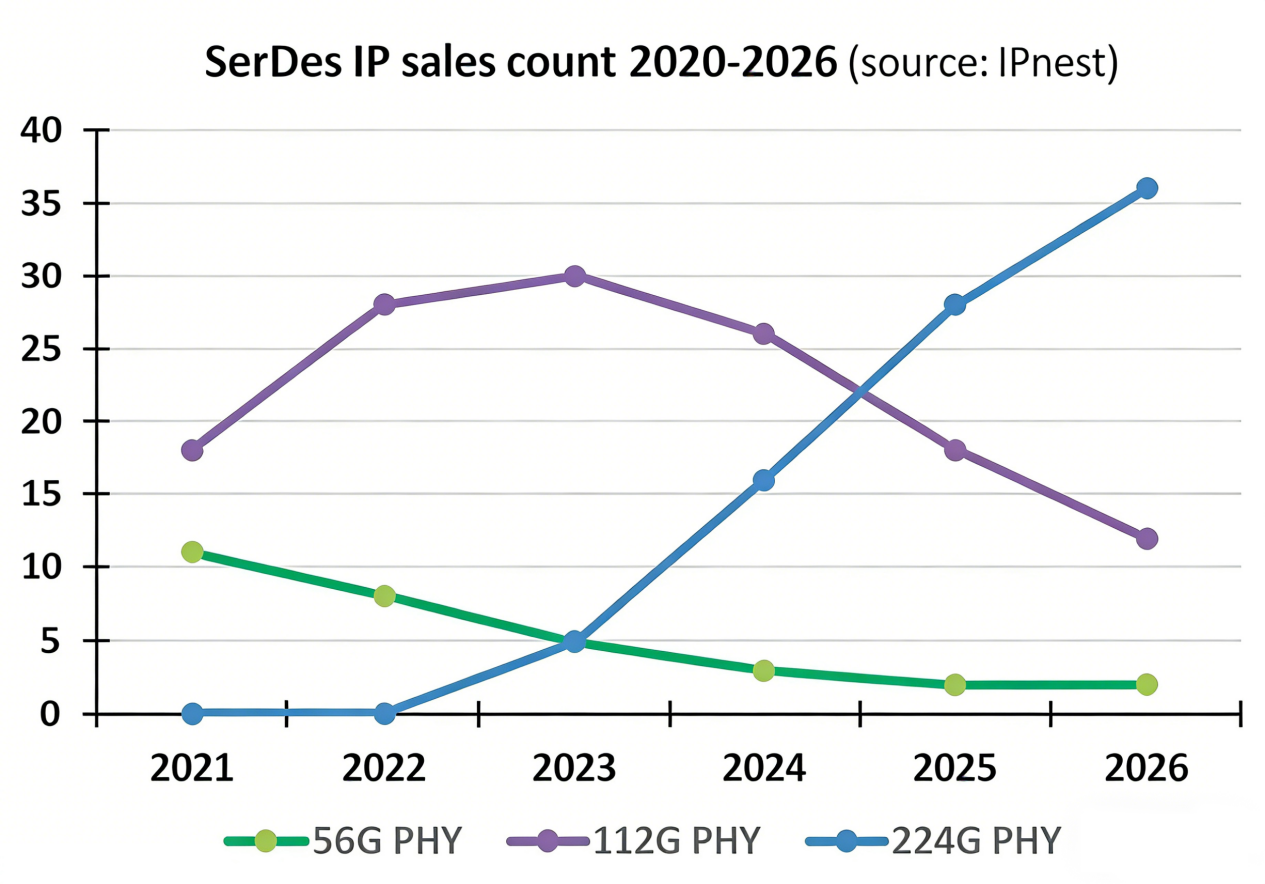
Alignment with Next-Gen ASICs: As switch bandwidth reaches 51.2T or 102.4T, using 112G lanes would result in unmanageable cabling complexity. 224G SerDes allows a single module to achieve 800G (via 4x224G) or 1.6T, meeting the high-density needs of core AI switches.
Figure 2: 56G, 112G and 224G SerDes IP sales count (Source: IPnest)
Compared with earlier optical module designs, OSFP224 modules provide several advantages:
Higher Electrical Bandwidth: 800G optical modules typically implement either 8×100G PAM4 lanes or 4×200G electrical architectures, depending on the optical design and DSP implementation.
Compatibility With AI Networking Hardware: Many next-generation AI switches and accelerator platforms are designed around OSFP modules, making OSFP224 the preferred form factor for high-density data center deployments.
Key Specifications of 800G OSFP224 Optical Transceivers
800G OSFP224 InfiniBand XDR transceivers typically support several optical interface standards designed for different transmission distances. Many modern AI networking platforms deploy
800G OSFP224 DR4 optical transceivers to provide high-bandwidth connectivity between InfiniBand XDR switches and GPU servers.
It uses advanced optical technologies such as:
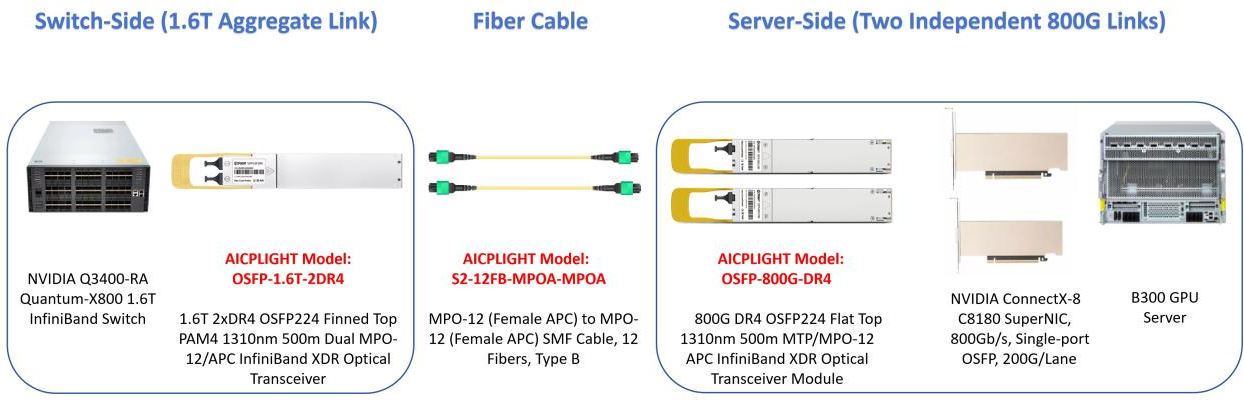
Together, these technologies enable extremely high bandwidth while maintaining signal integrity across high-speed optical links such as in 1.6T-to-two 800G Switch-to-Server Link, which is detailedly explained in 800G DR4 OSFP224 Transceiver vs. 800G 2xDR4 OSFP Transceiver.
Figure 3: This diagram illustrates a high-performance 1.6T-to-two 800G InfiniBand XDR network architecture, featuring an 1.6T 2xDR4 OSFP224 (OSFP-1.6T-2DR4) transceiver connecting a Quantum-X800 switch to two B300 GPU servers via 800G DR4 OSFP224 (OSFP-800G-DR4) modules.
These technical characteristics make 800G OSFP224 transceivers particularly suitable for large-scale AI networking environments.
Why 800G InfiniBand XDR Matters for AI Clusters
Large-scale AI training systems rely on thousands of GPUs working in parallel. During distributed training, GPUs constantly exchange gradients and model parameters with each other.
This communication pattern creates enormous network traffic. Without a high-performance network fabric, GPU clusters can experience serious performance bottlenecks. 800G InfiniBand XDR addresses these challenges by providing:
-
Massive Bandwidth: With 800Gbps per port, XDR networks dramatically increase the available bandwidth between GPU servers.
-
Low Latency Communication: InfiniBand is optimized for low latency communication, which is essential for operations such as All-Reduce used in distributed training frameworks.
-
Efficient GPU Scaling: High-speed networking allows clusters to scale from hundreds to thousands of GPUs without significant performance loss.
As AI models grow to trillions of parameters, these networking capabilities become increasingly critical.
Applications of 800G OSFP224 Modules
800G OSFP224 optical transceivers are deployed in a wide range of high-performance computing environments.
-
AI Training Clusters: Large GPU clusters used for training large language models require extremely high network bandwidth and low latency.
-
High-Performance Computing: Scientific simulations, weather modeling, and genomics research all benefit from high-speed interconnect technologies.
-
Hyperscale Data Centers: Major cloud providers are increasingly deploying 800G networks to support AI workloads.
In these environments, 800G optical modules serve as the fundamental building blocks of next-generation networking infrastructure.
Future Outlook: Toward 1.6T Optical Interconnects
While 800G networking is currently being deployed in leading AI data centers, the industry is already preparing for the next generation of optical interconnects.
1.6T optical modules are expected to become the next milestone, enabled by even faster SerDes technologies and improved optical components.
However, 800G InfiniBand XDR will remain a critical technology for many years as organizations continue to expand their AI infrastructure.
Conclusion
The rapid growth of artificial intelligence and high-performance computing is driving unprecedented demand for high-speed networking technologies. 800G InfiniBand XDR, combined with OSFP224 optical transceivers, represents a major step forward in enabling scalable AI infrastructure. By delivering massive bandwidth, ultra-low latency, and efficient GPU communication, these technologies are helping data centers support the next generation of AI innovation. As AI clusters continue to expand, 800G optical interconnects will play a central role in building faster, more efficient, and more scalable data center networks.

 English