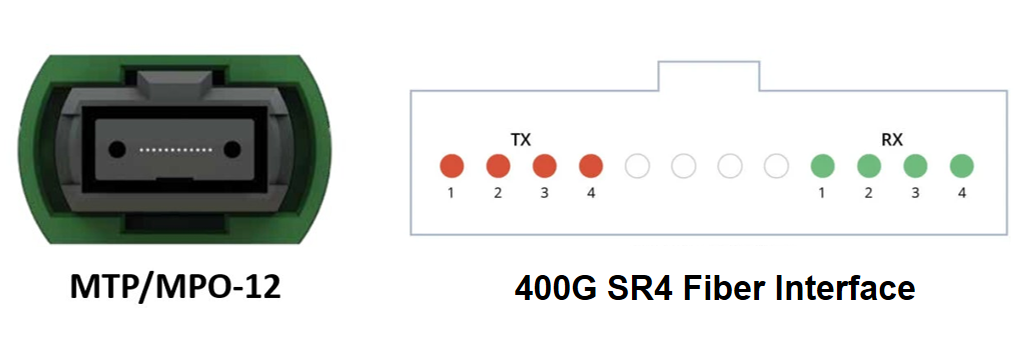
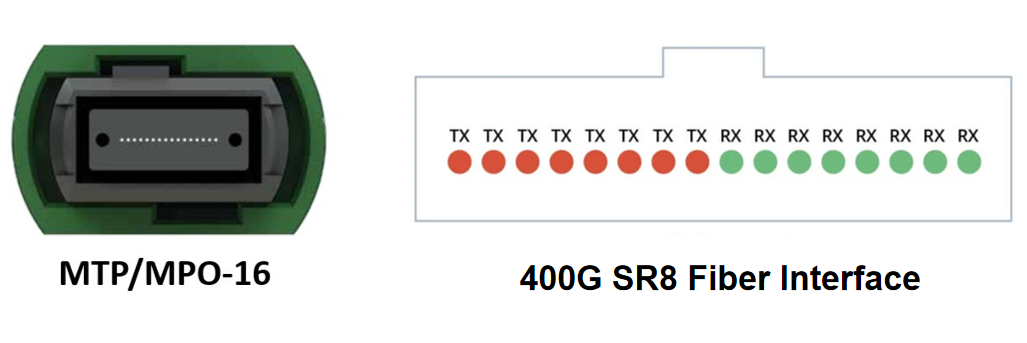
As 400G and 800G Ethernet become the foundation of modern AI data centers, parallel optics has emerged as the dominant transmission architecture. While much attention is placed on optical transceivers and switch ASICs, the choice of MPO connector—MPO-12 or MPO-16—plays a critical role in link compatibility, fiber utilization, and future scalability.
In 400G and 800G parallel optics, the choice between MPO-12 and MPO-16 connectors depends on the transceiver's lane architecture. MPO-12 is typically used for SR4 and DR4 modules, while MPO-16 is designed for SR8 architectures that fully utilize all 16 fibers. This article explains the differences between MPO-12 and MPO-16 connectors and provides practical guidance on selecting the right option for 400G and 800G parallel optics deployments.
Why MPO Connectors Matter in Parallel Optics
Parallel optical transceivers transmit data across multiple lanes simultaneously, rather than using a single serial optical channel. Each lane requires a dedicated fiber path, making connector fiber count and lane mapping fundamental to link operation.
MPO connectors aggregate multiple fibers into a single interface, reducing cabling complexity and enabling high-density deployments. However, not all MPO connectors are interchangeable, and choosing the wrong type can result in unused fibers, incompatible interfaces, or limited upgrade paths.
What Is an MPO-12 Connector?
An MPO-12 connector contains twelve fibers arranged in a single row. In modern data center deployments,
MPO-12 is most commonly used with 4-channel parallel optical modules, such as SR4 and DR4 transceivers.
Key Characteristics of MPO-12 Connector
Typical Use Cases
MPO-12 has been widely adopted due to its compatibility with legacy 40G and 100G infrastructures, making it a familiar and flexible option for gradual network upgrades.
What Is an MPO-16 Connector?
An
MPO-16 connector contains sixteen fibers and was specifically introduced to support 8-
channel parallel optical architectures, where all fibers are actively used.
Key Characteristics of MPO-16 Connector
Typical Use Cases
By fully utilizing all fibers, MPO-16 provides a clean and efficient solution for SR8 and DR8-style transceivers, especially in environments optimized for maximum port density.
MPO-12 vs MPO-16: Key Differences
The choice between MPO-12 and MPO-16 is not about performance superiority, but about architecture alignment.
Fiber Utilization: MPO-12 leaves unused fibers in SR4/DR4 designs, while MPO-16 uses all fibers in SR8 configurations.
Compatibility: MPO-12 offers broader compatibility with existing 40G/100G/400G SR4 and DR4 ecosystems.
Density Optimization: MPO-16 is better suited for native 8-lane designs and simplifies cabling for high-speed switch ports.
Upgrade Strategy: MPO-12 supports flexible breakout scenarios, whereas MPO-16 aligns well with purpose-built 800G SR8 deployments.
Choosing the Right MPO Connector for OSFP and QSFP-DD Modules
Connector selection often depends on the optical module form factor and lane architecture.
QSFP-DD Modules: QSFP-DD transceivers are commonly deployed in both SR4/DR4 and SR8 configurations. As a result:
OSFP Modules: OSFP transceivers are optimized for higher power and bandwidth density. Many 800G OSFP designs favor:
At AICPLIGHT, MPO connector selection is validated alongside optical modules to ensure correct lane mapping, polarity alignment, and long-term scalability in AI data center environments.
MPO-12 or MPO-16: Which One Should You Choose?
There is no universal better connector—only the right connector for the application.
Choose MPO-12 if:
-
You are deploying SR4 or DR4 transceivers
-
Breakout flexibility is required
-
Compatibility with existing MPO-12 infrastructure is important
Choose MPO-16 if:
-
You are deploying native SR8 transceivers
-
Maximizing fiber utilization and port density is a priority
-
The network is designed specifically for 800G parallel optics
Conclusion
In 400G and 800G parallel optics, MPO connector selection directly impacts fiber efficiency, compatibility, and future upgrade paths. MPO-12 remains a versatile choice for SR4 and DR4 architectures, while MPO-16 is purpose-built for SR8 designs that fully leverage 8-lane parallel transmission. By aligning MPO connector type with transceiver architecture and network design goals, AI data center operators can build scalable, high-performance infrastructures with fewer deployment risks.

 English