
 English
As data center bandwidth demands continue to surge, driven by AI training clusters, hyperscale computing, and large-scale cloud infrastructure, 400G optical modules have become essential components in high-speed interconnect networks. The choice of 400G module form factor directly impacts network compatibility, thermal performance, front-panel density, and long-term scalability.
Today's mainstream 400G optical modules use three primary form factors: QSFP-DD, OSFP, and QSFP112. Each offers distinct advantages in terms of physical design, bandwidth implementation, power/thermal capability, and ecosystem maturity. This article provides a comprehensive comparison of the three - QSFP-DD vs. OSFP vs. QSFP112.
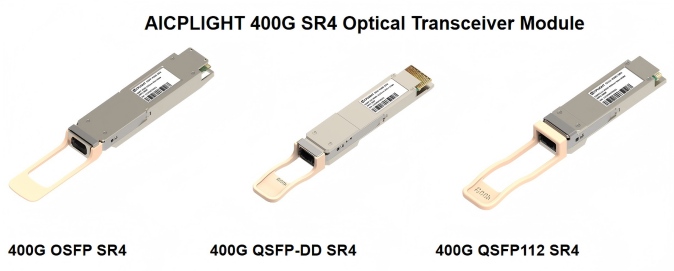
QSFP-DD vs. OSFP vs. QSFP112: Core Technical Differences
The divergence among the three 400G form factors fundamentally reflects different priorities across the industry: compatibility, high performance, and future evolution. The major differences among QSFP-DD vs. OSFP vs. QSFP112 are concentrated in four key dimensions:
- Physical structure & size
- Electrical/optical lane design
- Power consumption & heat dissipation
- Network & hardware compatibility
400G QSFP-DD: Compatibility-Driven Double-Density QSFP Solution
QSFP-DD (Quad Small Form-factor Pluggable - Double Density) achieves 400G by adding a second row of high-speed electrical channels to the traditional QSFP design, resulting in an 8×50Gbps PAM4 implementation.
Key Features:
- Physical Size: Maintains a form factor similar to the QSFP series.
-
Compatibility: Can be deployed in the same port types as QSFP/QSFP28. It facilitates upgrades from 100G/200G to 400G without needing to replace the entire chassis architecture.
- Typical Power Consumption: Approximately 10 - 14W.
- Ecosystem: Has the most mature industry ecosystem and strong compatibility.
Applicable Scenarios:- Traditional data centers with QSFP28 infrastructure
- Cost-sensitive operators upgrading from 100G/200G
- Enterprises requiring minimal hardware changes during migration
400G OSFP: High-Performance Form Factor for High-Power Environments
OSFP (Octal Small Form-factor Pluggable) also uses 8×50Gbps PAM4 lanes but has a significantly larger body (22×107mm) with a built-in heatsink design. Unlike QSFP-DD, OSFP is not mechanically compatible with any QSFP series. OSFP is engineered to support higher power budgets, making it ideal for next-generation modules such as 800G (8×100G) and 1.6T (8×200G).
Key Features:- Thermal Capacity: The larger volume and enhanced thermal structure support power consumption significantly higher than QSFP-DD.
- Typical Power Consumption: Can reach 15-20W at the 400G level, providing a distinct advantage for future 800G/1.6T high-power scenarios.
- Evolution Path: Designed with space reserved for future evolution to 800G (8×100Gbps) and 1.6T (8×200Gbps).
- Compatibility: It is not interoperable with the QSFP series.
Applicable Scenarios:- AI training clusters
- High-density HPC systems
- Liquid-cooled or high-thermal-load data centers
- Hyperscale cloud operators building new facilities
400G QSFP112: 4×100G Lane Architecture for High Efficiency
QSFP112 adopts a different lane architecture to achieve 400G: 4×100Gbps PAM4. Its form factor remains consistent with the traditional QSFP/QSFP28 design, enabling installation into standard QSFP ports (though not compatible with QSFP-DD slots). Compared with 8-lane modules, QSFP112 reduces lane count and internal components, allowing for lower complexity and improved power efficiency.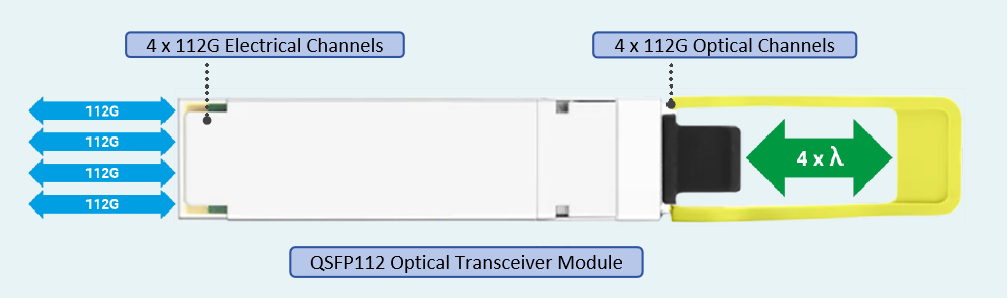
Key Features:
- Channel Structure: The 4×100G PAM4 design simplifies the internal structure compared to 8-channel solutions, potentially reducing power consumption and complexity.
- Compatibility: Can be inserted into QSFP/QSFP28 ports, but not compatible with QSFP-DD slots.
- Typical Power Consumption: Approximately 8-12W.
- Evolution Path: Offers smooth upgrade potential to 800G (4×200Gbps) while maintaining the same channel structure.
Applicable Scenarios:- High-density, power-efficient hyperscale data centers
- Cloud operators planning phased upgrades of QSFP-based networks
- Operators prioritizing long-term cost efficiency & port density
QSFP-DD vs. OSFP vs. QSFP112: Which Fits Your Deployment?
The three 400G form factors are not rivals fighting for a single winner. They serve different roles based on deployment priorities.
Existing Network Upgrade Priority - 400G QSFP-DD: If your core demands are low cost and rapid deployment, and existing equipment primarily uses QSFP28 ports, the compatibility advantage of QSFP-DD will maximize the protection of incumbent investment. It avoids the need to replace hardware like switches and cabinets, making it especially suitable for bandwidth expansion needs in traditional enterprise data centers and small to medium-sized cloud service providers.
New High-Performance Cluster Priority - 400G OSFP: For scenarios such as AI training, supercomputing centers, and liquid-cooled data centers, OSFP's high-power support, strong thermal management capability, and 1.6T upgrade potential are the core competitive advantages. These scenarios have extremely high requirements for performance stability and future scalability, and OSFP can avoid frequent equipment iteration caused by business growth, leading to a better long-term TCO (Total Cost of Ownership).
High-Density and Power Efficiency Priority - 400G QSFP112: For users sensitive to port density and power consumption, such as cloud vendors and large data centers, QSFP112's 4×100Gbps channel design allows for the deployment of more ports in the same cabinet space while simultaneously reducing energy costs. Its compatibility with existing QSFP ports also makes phased upgrades more flexible for medium-to-large networks, representing a balanced choice that considers both current efficiency and future evolution.Application Scenario Recommended Form Factor Key Advantages Migrating Existing QSFP28 Infrastructure from 100G to 400G QSFP-DD Delivers maximum investment protection by enabling a seamless upgrade path without replacing existing hardware front panels. Next-Generation AI Training Clusters / HPC Systems / High-Thermal-Load Environments OSFP Provides superior thermal headroom and higher power capacity, ensuring long-term scalability for upcoming 800G and 1.6T deployments. High-Density, Power-Optimized Hyperscale Cloud Data Centers QSFP112 Offers exceptional energy efficiency with fewer electrical lanes while maintaining full compatibility with traditional QSFP faceplates. Seeking long-term scalability and balanced cost QSFP112 / OSFP Both form factors deliver robust scalability for future network evolution, each with unique performance and deployment benefits.
AICPLIGHT 400G QSFP-DD/OSFP/QSFP112 Optical Module
AICPLIGHT delivers a full portfolio of 400G QSFP-DD, OSFP and QSFP112 optical modules designed for extreme performance, seamless compatibility and future-ready scalability. Engineered for cloud data centers, AI training clusters and hyperscale networks, AICPLIGHT 400G solutions combine low-latency transmission, industry-leading reliability and superior thermal stability.
Whether you need maximum interoperability with QSFP ecosystems, high-power OSFP performance for AI/HPC workloads, or energy-efficient QSFP112 modules for dense cloud architectures, AICPLIGHT enables you to build faster, greener and more scalable networks.Model Description QDD-400G-SR4 400GBASE-SR4 QSFP-DD PAM4 850nm 100m DOM MPO-12/APC MMF Ethernet Optical Transceiver Module, Breakout to 2 x 200G-SR and 4 x 100G-SR QDD-400G-SR8 400GBASE-SR8 QSFP-DD PAM4 850nm 100m DOM MPO-16/APC MMF Ethernet Optical Transceiver Module QDD-400G-DR4 400GBASE-DR4 QSFP-DD PAM4 1310nm 500m DOM MPO-12/APC SMF Ethernet Optical Transceiver Module QDD-400G-FR4 400GBASE-FR4 QSFP-DD PAM4 1310nm 2km DOM Duplex LC/UPC SMF Ethernet Optical Transceiver Module OSFP-400G-SR4 400GBASE-SR4 OSFP Flat Top PAM4 850nm 100m DOM MTP/MPO-12/APC MMF Ethernet Optical Transceiver Module OSFP-400G-DR4 400GBASE-DR4 OSFP Flat Top PAM4 1310nm 500m DOM MPO-12/APC SMF Ethernet Optical Transceiver Module Q112-400G-SR4 400GBASE-SR4 QSFP112 PAM4 850nm 50m DOM MPO-12/APC MMF Ethernet Optical Transceiver Module Q112-400G-DR4 400GBASE-DR4 QSFP112 PAM4 1310nm 500m DOM MPO-12/APC SMF Ethernet Optical Transceiver Module
Market Landscape and Future Trends
Currently, 400G QSFP-DD is the short-term mainstream due to its compatibility and cost advantages. OSFP is rapidly penetrating the AI and supercomputing fields due to its high-performance positioning. QSFP112 is gaining momentum, benefiting from cloud vendors' demand for density and power efficiency, and currently shows the fastest growth rate.
Over the next 3-5 years, the competition will result in a differentiated coexistence pattern:
QSFP-DD will continue to dominate the legacy upgrade market.
OSFP will solidify its advantage in high-end scenarios such as AI, supercomputing, and liquid cooling, with its technical premium becoming more pronounced as 1.6T scales.
QSFP112 is expected to become the new favorite in cloud data centers, leveraging its superior power efficiency and port density as single-channel 100G technology matures.
Ultimately, enterprises should select the solution that offers the best long-term value based on their existing equipment ecosystem, power consumption and thermal capacity, data center density planning, and future bandwidth expansion roadmap.


